



When researching laser skin treatments, you’ll often see the terms ablative and non-ablative. These words describe how a laser treatment interacts with the skin’s surface.
The term ablate is defined as “to remove or destroy tissue,” which in aesthetic medicine refers to removing a controlled portion of the outer skin layer. Non-ablative treatments, in contrast, work beneath the surface without removing the skin.
Both approaches stimulate collagen and improve overall skin quality. They can address many of the same concerns, including discoloration, textural irregularities, and wrinkles. The key difference lies in how the skin is affected during treatment and how it heals afterward.
What Is a Non-Ablative Laser?
Non-ablative lasers and energy-based devices deliver controlled energy into deeper layers of the skin while leaving the outer layer intact. The energy is absorbed within the tissue, triggering collagen remodeling.
Because the epidermis is not removed, the skin barrier remains intact. Recovery is typically limited to temporary redness or mild swelling, depending on the device and treatment settings.
Examples of Non-Ablative Lasers We Carry
- BBL (BroadBand Light) – Targets pigment and vascular irregularities using light energy. Treated pigmentation may temporarily darken, rise to the surface, and shed over approximately one week.
- Laser Toning – Refines overall skin tone and reduces diffuse redness while stimulating collagen. Most patients experience mild flushing for 12–24 hours, though some skin types may notice redness lasting slightly longer.
- Ultherapy – Uses focused ultrasound to stimulate collagen in deeper structural layers of tissue. Temporary swelling or tenderness can occur.
Non-ablative treatments may be appropriate for patients who:
- Have mild to moderate discoloration or redness
- Have limited availability for visible recovery
- Want to maintain results following a prior ablative treatment
- Are looking to improve overall skin tone and texture
What Is an Ablative Laser?
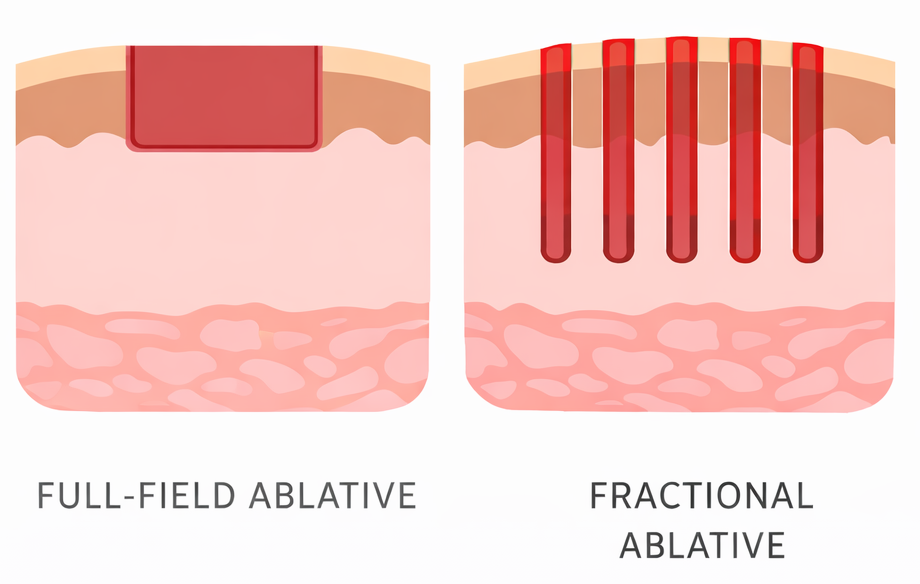 Ablative lasers remove a controlled portion of the outer skin layer while also delivering energy into deeper tissue. By resurfacing the epidermis, they stimulate collagen remodeling and new skin regeneration during the healing process. Depending on the device, this may involve removing a uniform depth of surface tissue or using fractional technology to create microscopic treatment columns surrounded by untreated skin, which supports more efficient healing.
Because the outer layer is disrupted, visible recovery is expected. Redness, mild to moderate swelling, and a period of dryness with surface shedding (sloughing) are common, and recovery time varies based on treatment depth and individual response.
Examples of Ablative Lasers We Offer
- Halo Laser – A hybrid fractional laser that delivers both ablative and non-ablative wavelengths to treat multiple depths of skin in a single session, improving texture and pigment irregularities. Redness, mild swelling, and surface shedding are expected for 5-7 days, depending on treatment depth..
- MicroLaserPeel – A superficial ablative resurfacing treatment that removes a uniform depth of surface tissue to refine texture and improve sun damage. Redness and several days of surface shedding are typical, with recovery reflecting its more superficial depth.
Ablative treatments may be appropriate for patients who:
- Have more advanced sun damage or textural irregularities
- Are concerned about deeper wrinkles or acne scarring
- Are seeking more noticeable correction in fewer treatments
- Are able to accommodate visible recovery time
Which Laser Treatment Is Appropriate?
Ablative and non-ablative treatments are not interchangeable. The appropriate choice depends on the depth of correction required, the condition of the skin, and how much recovery a patient is willing to accommodate.
Mild discoloration or early texture changes may respond well to non-ablative remodeling. More advanced sun damage, acne scarring, or deeper textural concerns often require resurfacing.
Selecting a device by category alone does not determine outcome. An in-person evaluation allows treatment to be matched to skin condition, goals, and recovery preferences.
If you’re considering laser treatment, schedule a consultation to determine which approach aligns with your skin type and treatment goals.